


How Seminary Shaped Cyndee’s Vision for Deeper Ministry
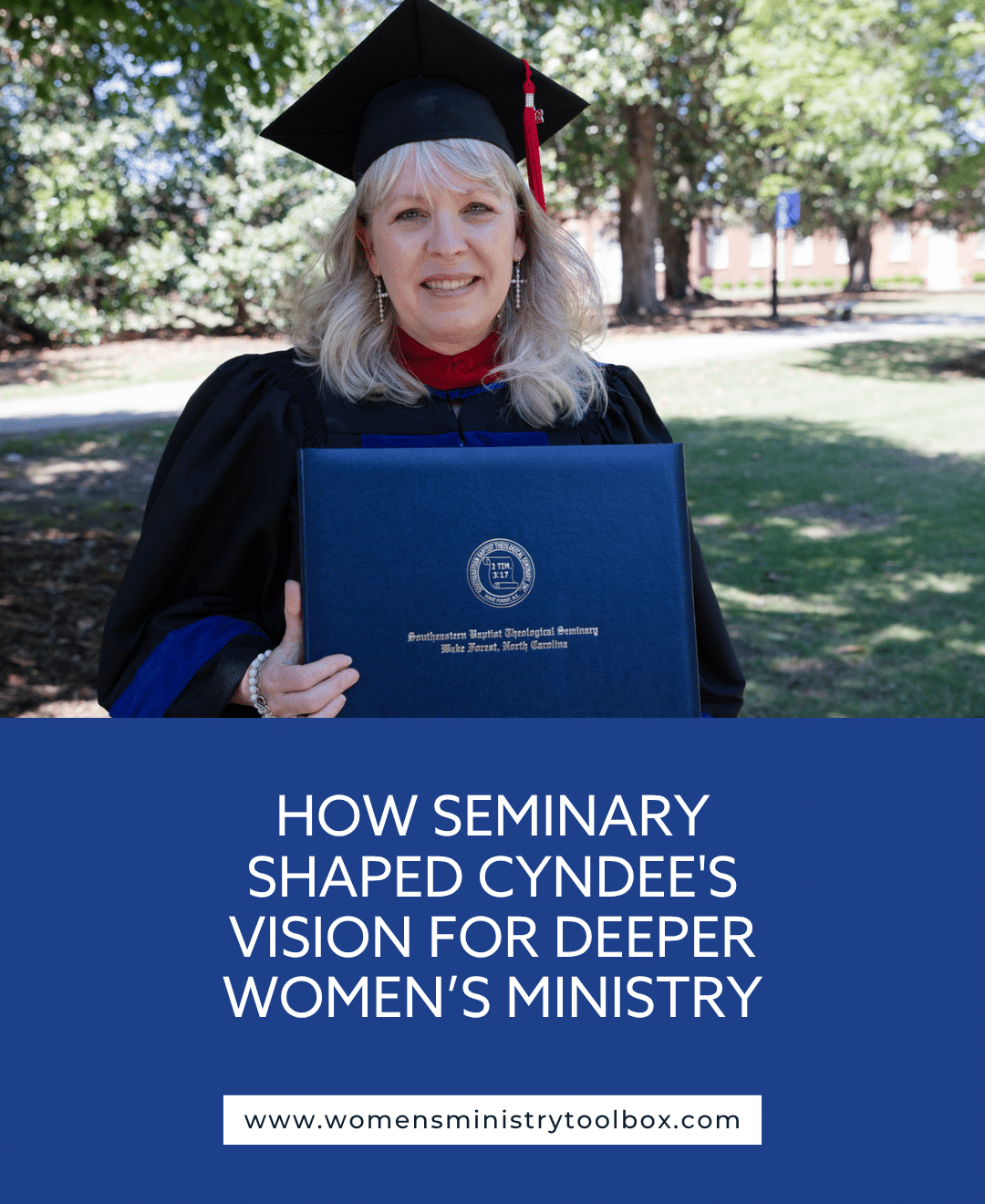
As some of you may know, I recently graduated from Southeastern Baptist Theological Seminary with my Masters in Ministry to Women.
When I began this journey just over three years ago, I joked with one of my mentors that I might launch a podcast documenting my seminary journey. I jokingly suggested calling it “Cyndee Goes to Seminary”. They responded that was a great idea.
The first few months of school I kept up a journal, but it quickly became clear I did not have the time or energy to add one more thing to my busy schedule. Another podcast was out of the question.
Instead, today I’m sharing a summary of my experience with you.
How did you know the Lord was leading you to go back to school?
Many of you have asked, “how?”
- How did you know the Lord was leading you to go back to school?
- How did you manage to do it all?
Today, I’ll answer that first how – How did you know the Lord was leading you to go back to school?
On the next podcast episode, I’ll share in a lot more detail how I was able to do it. Most, if not all of the tips, will be applicable to anyone with a busy schedule.
Let’s start with the back story and then I’ll answer some of the questions you all submitted about my seminary experience.
Why did I go back to school?
I graduated in 1995 with a double bachelor’s degree in elementary education and English. I had initially planned on becoming a child psychologist. My first psychology class was not nearly as interesting as I expected, and I quickly learned I was going to need to go to school for at least an additional two years, which I had zero desire to do. I couldn’t wait to graduate. I share that to help you understand I never wanted to or expected to go back to school.
I’ve learned to be very careful about telling God I won’t ever do something. Every time I wind up eating crow.
There were a few things that transpired in the spring of 2023 which seemed like nudges from the Lord to consider going back to school. I wish I had written them all down, because some details are fuzzy looking back. I’ll do my best to explain how I knew this was what God wanted me to do.
First, I was encouraged by other women I knew who were pursuing ministry degrees.
I was a good student and generally enjoyed my classes, even if I had been ready to graduate college and start my life. I love reading and writing, so those tasks didn’t intimidate me.
But God got my attention in a big way at a conference I was attending out-of-state on a seminary campus.
As part of the conference registration, there was a pre-conference training option that would count for continuing education credits. In the back of my head, I thought, hmmm… maybe I’ll need those someday.
Then I met a friend for dinner before the conference started. Completely out of the blue, she asked me if I had ever considered going to seminary. A year before, I would have laughed and said no, but as I mentioned, God had put it on my radar in the months leading up to this conference.
When I got back to my hotel after dinner, I texted my husband, “I think I’m supposed to go to seminary.” I hadn’t said a word prior about the previous nudges from the Lord. We had just finished helping to pay for our son’s college degrees. He texted back “I think you should think about it some more.”
That night when we talked, I had the chance to explain why I felt strongly that this was something God wanted me to pursue. I even did a bit of searching online to look at possible programs and schools.
When I returned home, I sent two emails. One to our senior pastor, asking for his advice and recommendations, and a second to a mentor who had returned to school to work on her doctorate at age 68.
I received quick responses from both. My pastor had both degree and school recommendations for me, and my mentor, Pat, thought it was a great idea. She suggested I look for a school that aligns with my beliefs (I’m a complementarian) and try to find somewhere close enough that I could be on campus occasionally. Southeastern checked all those boxes.
I worked on my application, lined up my references, and submitted all of the necessary paperwork in May. The website said to expect to hear something in 3-4 weeks. Part of me wasn’t sure I’d even be accepted. I had no idea how many applications were approved and how many were not. I had been obedient to do what I thought the Lord was calling me to do, and I decided I would do my best to wait patiently and not think about it. I didn’t have to wait long! I received an acceptance letter in about 24 hours. I was stunned.
The summer semester had just begun, so I quickly found a class needed for my degree and got started.
What it was really like to go back to school?
My first class was Christian Ethics. I had jumped straight into the deep end of the pool without knowing. This was not an easy class to start with.
There were several times over the summer that I questioned if I was really supposed to be doing this.
- It wasn’t easy.
- Adjusting to academic reading was a challenge.
- The speed, especially of certain classes, was rough.
For example, the number of books of the Bible I had to read for Old Testament 2 this past semester was daunting.
While I was praying through whether or not to go back to school, I spent some time on the phone with a later-in-life graduate I had met at the conference I mentioned earlier. She is actually an adjunct professor at Moody who had recently completed her master’s degree. I asked her about the time commitment. She shared that she was able to plan one day per week per class to take care of her classwork. That sounded pretty manageable to me. I knew I didn’t want to stop all the things I do for my Women’s Ministry Toolbox community. I still wanted to write, record podcasts, and create new resources. I was even planning to take fewer speaking engagements for the time being.
While not every school load is the same, my workload at Southeastern was quite a bit heavier than I expected. Add my menopause-fogged brain into the equation, and this was not easy, but it was worth it.
While our boys had taken some online classes, they were capable of managing all of that themselves.
I had to learn how to:
- navigate a new online learning environment
- check out and view resources from the library online
- write and cite papers using the Turabian format.
I frequently felt I was in over my head.
I regularly prayed, “Lord, please send help.”
How God answered my prayer for help:
One day, that first summer semester, I opened up my Women’s Ministry Toolbox inbox to find a note from a reader who just so happened to be a later-in-life student at Southeastern. She offered to talk with me and answer any questions I might have. God answered my prayer by sending Dee.
I scheduled a Zoom call with Dee, and we clicked immediately. She was a tremendous help! I was blessed to attend a hybrid-class on campus with her that fall. She was an incredible encourager and prayer warrior for me over these three years.
Now that you have that background information, let me get to the rest of your questions.
Lori asked: What was required for your degree?
I completed 49 hours. The program has changed slightly, and the requirement is now 51 hours.
Twelve hours were committed to specific required women’s ministry courses, including Counseling Women, Foundations for Ministry to Women, and Biblical Theology of Womanhood. I had to select one ministry to women elective class.
The rest of my classes were the same as any other master’s program for men or women. It included two semesters of New Testament, two semesters of Old Testament, 2 semesters of Christian Theology, Christian Ethics, Intro to Great Commission Studies, Baptist History, and Personal Discipleship & Disciple-making,
We also had to take an intro to seminary mini-class, Sex Abuse Prevention & Response Training, and complete a mission trip or internship.
Every class included reading and writing assignments and class lectures to watch.
Kristie asked: How were you able to take more than one class at a time?
Over the last three years, I was in school year-round except for the summer I was writing Women’s Ministry Essentials. I took a winter class over the Christmas break last winter as well. For the summer classes, which are about 4 weeks shorter with the same amount of content, I took just one class. In the fall and spring semesters, I initially took two classes each semester. There were a couple of 8-week classes in the mix. In my last fall and spring semesters, I took three classes. (Which I wouldn’t recommend.)
I did all of this while continuing to produce resources and material for my Women’s Ministry Toolbox ministry, writing a book, serving in our church, and managing our household.
I’ll get into the nitty-gritty details on the next podcast episode, but I found I had to schedule everything. I found a daily planner with 30-minute time slots. I would plan my week on Sunday and did my best to stick with the schedule.
Jennifer asked: How did you have time to do it all – ministry, family, and school?
I didn’t have time to do it all. There were a lot of things I had to say no to.
I worked harder some weeks so I could enjoy family vacations, attend a conference, or go on our women’s retreat.
I had to be prayerful and intentional. Often that meant working on schoolwork or writing in the evenings.
I did my best to always honor the Sabbath each week. To be honest, I did a much better job in the first two years of school and struggled much more with that in the last year.
I turned down several really great opportunities and even purchased tickets to a conference and later decided it was best not to attend. I wound up being so glad I stayed home. I don’t know how I would have gotten all of my assignments completed on time.
Andrea asked: How did this affect your relationship with Christ?
Scheduling my quiet time helped me to be faithful to be in God’s Word Monday through Friday each week. If I was preparing to speak or teach, or when I was taking Old or New Testament, reading those passages was my quiet time.
- The foundation of my faith was strengthened by being in the Word consistently.
- I grew in my knowledge and understanding of God’s Word.
- I got to think deeply about things I had never considered.
- I was introduced to new concepts and new terminology.
- My love for God and His Word grew even greater.
Southeastern is known for being very focused on the Great Commission. The importance of sharing the gospel was emphasized in our classes. It encouraged to be even more evangelistic. You’ve probably noticed the slight shift in what I’ve written for the Women’s Ministry Toolbox blog.
Jennifer asked: How did school impact my view of women’s ministry?
Because I’ve been involved in ministry to women for over 25 years and I try to keep up with current trends and recent research, I expected most of my growth was going to come from my other classes. I read a lot of women’s ministry-focused books in those core ministry to women classes.
- I found my views on women’s ministry were reinforced by what we read and discussed.
- Sitting in front of seasoned teachers was beneficial, too. I gleaned teaching tips and ideas from my professors.
- I became even more convinced of the importance of discipleship and the importance of discernment and research in selecting resources.
- I was encouraged to take women even deeper.
For one of my assignments, I had to create a women’s ministry event focused on a specific doctrine of Christ. The scripture passage, teaching, and worship songs all needed to reinforce that focus. That’s something I never would have thought of before seminary.
I have always valued training for women’s ministry leaders. But I am even more passionate now about women’s ministry leaders and directors receiving additional training, whether that’s through seminary or a certification program.
Norma asked: How do you believe your degree will help you minister to women?
As I mentioned, I want to take women even deeper.
I’m aware of more resources, especially for counseling. Dr. Kellen’s book, Counseling Women, is a resource I’ll use and recommend on repeat. Thinking about counseling as discipleship was huge for me.
I’m even more passionate about making sure women hear the gospel and are encouraged to respond to the gospel.
I have a sense of greater urgency – let’s not waste time on fluff or shallow teaching – but I think it’s in response to the culture, not necessarily going to school.
I have a list of professors and books to use as resources that I didn’t have before. I’ve even created a list of my favorite seminary books you can find here.
My Support System
It was truly God’s grace and provision that sustained me these last three years. I’m so thankful for the support of my husband, my church community who checked in with me and prayed for me, and for you all and the extra grace given with unexpected breaks and delayed email responses.
Thank you for your support and encouragement. It kept me going.
You may also want to check out:
Women’s Ministry Essentials: How to Build and Sustain a Thriving Christian Community
My Favorite Seminary Books
Counseling Women: Biblical Wisdom for Life’s Battles
5 Great Benefits of Women’s Ministry Training
Women’s Ministry Team Training Ideas
Academic Planner I Used


+ view comments . . .